Human-in-the-Loop: Why Automation Requires Oversight

In the modern enterprise, the allure of full automation is undeniable. The potential for near-instantaneous decision-making, infinite scalability, and the elimination of human error provides a strong incentive to automate high-stakes workflows. However, as organizations race to deploy artificial intelligence, a critical reality has emerged: the most robust automated systems are not those that operate in isolation, but those that intentionally integrate human judgment.
This is "Human-in-the-Loop" (HITL). A foundational design paradigm that frames automation as a collaborative partner rather than a replacement for human oversight. By embedding human intervention at critical junctures, organizations leverage AI's speed while preserving the safety, accountability, and nuanced decision-making essential to human expertise.
The Spectrum of Human Integration
The role of the human in an automated workflow is not a binary choice between manual control and total autonomy. It exists on a functional spectrum defined by the level of oversight required.
Human-in-the-Loop (HITL): The strictest level of oversight. The AI pauses its process to wait for human approval before moving forward. This is essential for high-stakes, irreversible actions where the cost of a false positive is catastrophic.
Human-on-the-Loop (HOTL): The AI operates autonomously while a human monitors the system's performance. The human retains "veto power," intervening only when the system deviates from expected parameters.
Human-out-of-the-Loop (HOOTL): Full autonomy. The AI handles all sensing, decision-making, and action. This is reserved for environments where the speed of execution must exceed human reaction times to be effective.
Effective organizations do not treat these as static states. Instead, they strategically choose where to insert human involvement throughout the AI development lifecycle—from training and tuning to real-time inference.
Defining Value Through a Task-Based Framework
To realize actual business value from AI, leaders must move beyond the hype and deconstruct the nature of work itself. As economist Erik Brynjolfsson posits, the job is not the fundamental unit of analysis; the task is.
By breaking down roles into discrete, atomic tasks, organizations can apply a "Suitability for Machine Learning" (SML) rubric. This analysis reveals that most jobs are a mix of routine processes—prime for automation—and complex, sensitive interactions that require human oversight.
When we shift our perspective from "AI as a replacement" to "AI as a complement," we avoid the pitfalls of Jevons' paradox, where increased efficiency in resource use leads to higher overall consumption. Rather than rendering humans obsolete, human-in-the-loop (HITL) frameworks allow employees to focus on high-value, novel, or nuanced problems, while AI manages high-volume data processing.
The Cognitive Vulnerabilities of Automation
While HITL is designed to act as a safety architecture, it is not immune to failure. Ironically, the presence of automation can introduce its own set of psychological vulnerabilities that, if left unmanaged, can render oversight ineffective.
Automation Bias: The tendency for humans to accept machine suggestions even when contradictory information is present. This manifests as errors of commission (following bad advice) or errors of omission (failing to act because the system didn’t prompt them).
Automation Complacency: A form of "learned carelessness" where operators, seeing the system perform reliably for long periods, reduce their monitoring vigilance.
The Out-of-the-Loop (OOTL) Phenomenon: When automation takes primary control, human operators often struggle to maintain situational awareness. If a system failure suddenly occurs, the delay in the human's ability to comprehend the system state can lead to catastrophic response times.
Recent industry history provides sobering examples of these failures. From the Zillow Offers predictive model debacle in 2021—where a lack of human recalibration to market volatility led to $500M in losses—to the 2026 finance protocol exploit caused by unvetted AI-generated code, the lesson is clear: outsourcing decision-making to AI does not absolve an organization of accountability. Whether through legal mandate or financial liability, the human remains the final bearer of responsibility.
Designing for Resilience: Best Practices
If oversight is to be effective, it must be "designed in" from the start. Bolting on human intervention as an afterthought rarely yields a secure system. Organizations should adopt the following principles to build resilient oversight architectures.
Cognitive Forcing Functions
To combat automation bias and complacency, designers should introduce intentional, subtle friction into workflows. These "Cognitive Forcing Functions" force the user to engage with the data before moving forward. By requiring a manual confirmation of logic or a brief review of supporting evidence, you interrupt the cycle of mindless "auto-approving" and ensure the human remains mentally active in the process.
Management by Exception
Oversight does not mean burying operators in mundane data. Effective systems utilize risk-based routing:
Low-Risk/High-Confidence: Managed via full automation to maximize throughput.
High-Risk/Low-Confidence: Diverted to human-in-the-loop workflows.
By designing systems to alert humans only when uncertainty thresholds are crossed, organizations preserve the operator’s mental capacity for when it is needed most.
Transparency and Explainability
An operator cannot oversee a system they do not understand. Dashboards must go beyond simple outputs; they must display the AI's confidence levels and, where possible, the rationale behind a recommendation. This transparency is not just for debugging—it is the foundation of the trust required for a human to make an informed "go" or "no-go" decision.
Simulated Training and Governance
Just as in aviation, human operators of complex AI systems should undergo regular simulation training for system failures. This maintains manual proficiency and mental readiness, ensuring that when the automation falters, the human is prepared to step in.
Furthermore, these processes must be governed by clear metrics. Tracking KPIs like "task resolution time" and "human intervention frequency" helps organizations distinguish between productive automation and systems that create invisible, high-speed risks.
The Path Forward
The objective of the Human-in-the-Loop principle is not to mandate perpetual human intervention at every stage. Rather, it is to use human involvement to train, tune, and monitor the system until it earns enough trust to move further along the spectrum of autonomy.
As AI systems mature, they will handle an increasing share of routine tasks, and the nature of human oversight will evolve. However, in high-stakes environments—healthcare, transport, finance, and beyond—the human will remain the essential safeguard. By embracing HITL as a core strategy, organizations do not just build faster systems; they build smarter, safer, and more accountable ones. The future of automation is not the end of human work, but the empowerment of human judgment through machine-speed intelligence.
Behind the Scenes : Using Rifful to Create this Blog Post
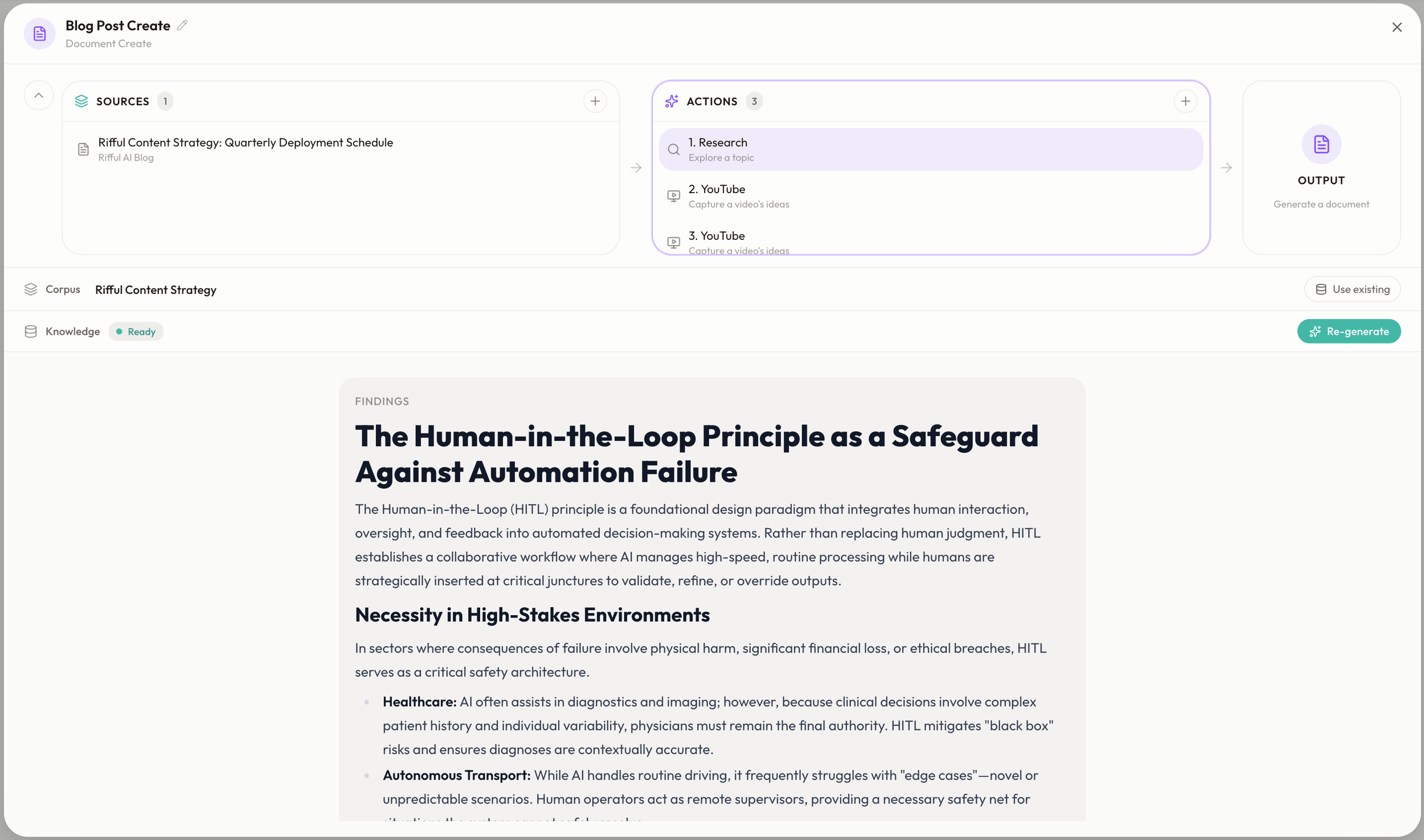
#1) Research and create a first draft with Riffuls “Document Create”
The first draft of this post was researched and generated using the Document Create experience
First, we added Riffuls Content Strategy to sources to make sure AI was grounded in the blog post schedule
Second, Actions were setup to have AI research the web and extract key insight for the blog topic
Finally, an initial draft document was created and saved to our workspace
#2) Fine-tune and polish with Riffuls “Write Together”
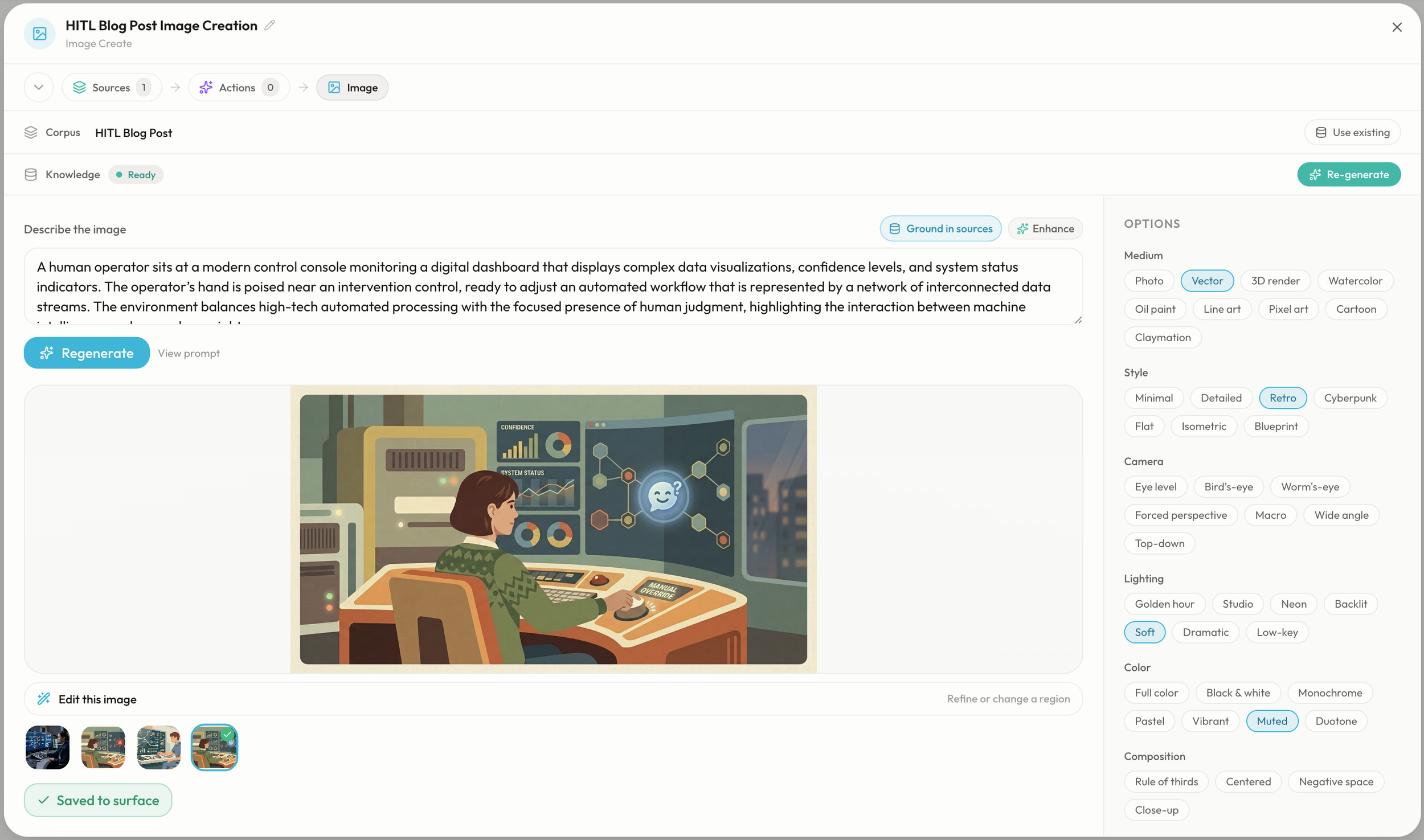
Once we had our initial draft it was time to polish and make it our own with the Write Together experience.
First, a manual pass to add anything missing, and re-write sections that we didn’t quite like
Second, we used the AI to make sure claims were fact checked and accurate
Finally, an improve and polish pass with the AI to make sure it all sounded just right
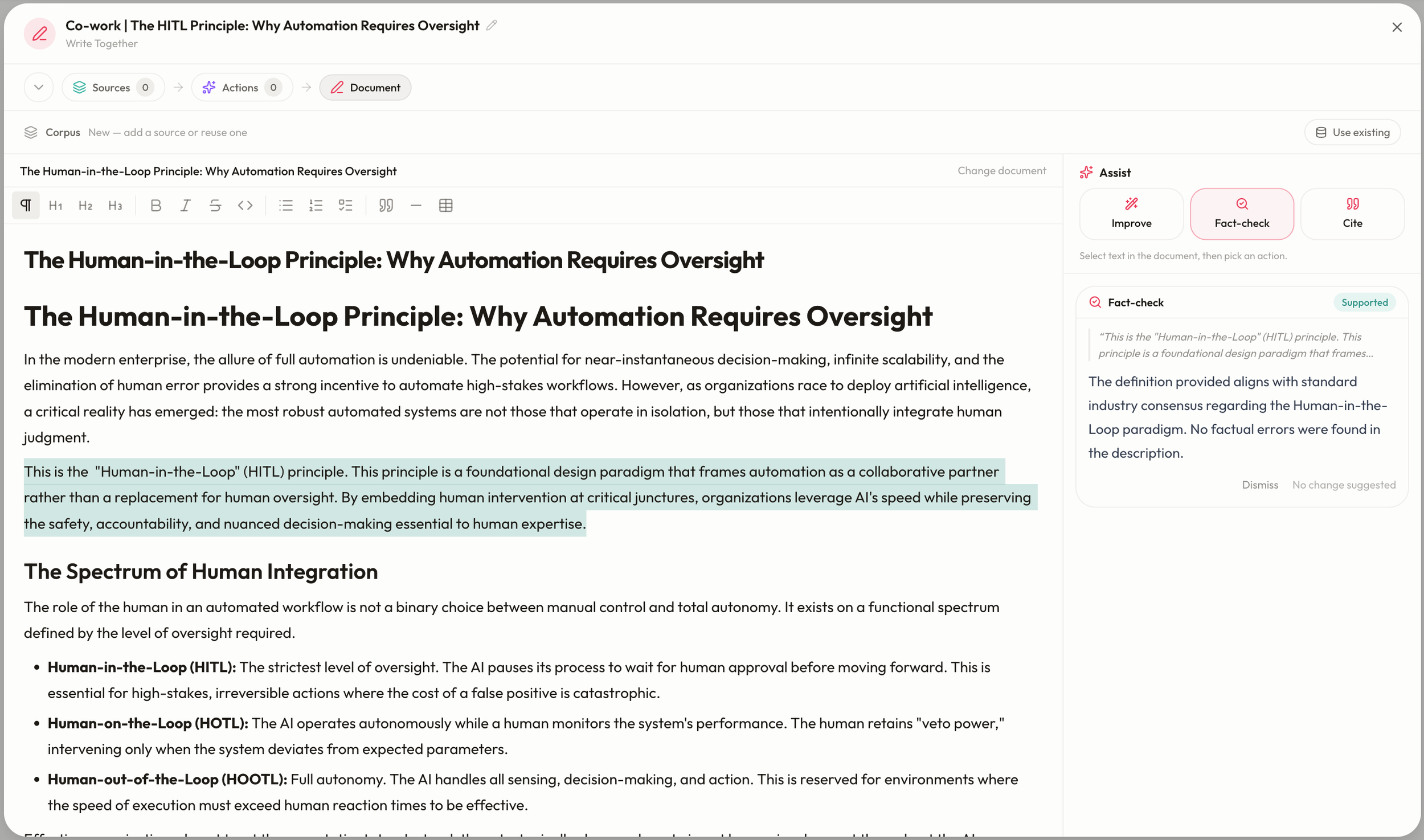
#3) Create a relevant image with Riffuls “Image Create”
Finally, we created a header image that fit the post with the Image Create experience.
First, we added the blog to the source list to give the AI the right context
Second, we gave a brief description of the image and let the AI ground its own prompt in our blog source
Finally, we generated and tweaked a few examples until we got what we were after