The Architecture of Authenticity: Preserving Your Brand Voice in an Age of Synthetic Noise

If you are currently feeling like your content marketing operation is trapped in a feedback loop of increasing volume and decreasing impact, you aren't alone. We’ve reached the "saturation point" of 2026. The internet is heavy with synthetic content—that polished, frictionless, and utterly hollow "AI slop" that satisfies an algorithm but leaves your reader cold.
As an architect of digital systems, I see this daily: brands attempting to scale by plugging their strategy into generic LLMs, only to find their unique brand personality—their "brand DNA"—evaporating into a statistical average. The machine is doing its job too well. It’s predicting the most probable next word, and in doing so, it’s stripping away the wit, the edge, and the human empathy that actually makes people care.
AI is great for building frameworks, but it has no soul. Stop treating it like a plug-in accessory; your brand voice should be the bedrock of everything you build.
The Statistical Average Paradox
When you ask a model to write in your voice without providing structural constraints, you are essentially asking it to aim for the middle. By design, these models want to sound "polite, professional, and safe."
But safety is the enemy of connection. When your brand sounds like everyone else, you’ve lost your "content moat"—the proprietary history, data, and human perspective that your competitors can’t easily mimic. If your reader can’t distinguish your content from a generic competitor's without looking at the logo, your strategy has failed. Research confirms that 77% of consumers now report that heavy reliance on AI-generated content actively diminishes brand authenticity. They are getting better at spotting the tropes, and they are starting to tune them out.
From PDF Style Guides to "Voice Engineering"
If your brand voice lives in a 40-page PDF tucked away on a shared drive, it is dead. AI doesn't read your style guide; it ignores it in favor of its own pre-trained weights. To maintain consistency, you must move toward AI prompt engineering for brand voice that functions like system-level architecture.
1. Behavioral Constraints are Non-Negotiable
Stop asking the AI to be "friendly" or "authoritative." These are subjective adjectives that models interpret through their own vast, generic training sets. Instead, engineer your prompts with explicit behavioral constraints:
"Use the second-person active voice."
"Never use industry jargon like 'synergy' or 'innovative'."
"Keep sentence length under 15 words to maintain a punchy, rhythmic cadence."
2. Grounding in the "Golden Dataset"
You cannot expect an AI to sound like you if it hasn't been exposed to your best work. Implement Human-in-the-loop (HITL) AI workflows where you utilize Retrieval-Augmented Generation (RAG). By grounding your models in a "golden dataset"—a collection of your highest-performing, human-written content—you force the system to mimic your actual performance metrics rather than the web-scraped average.
The Human-Led, AI-Fed Workflow
I often hear marketers ask: "How do I ensure AI content reflects our company values?" The answer isn't a better filter; it’s a shift in your operational model. Think of your workflow as "Human-Led, AI-Fed."
Let the machine handle the scaffolding: data-heavy reports, structural drafting, and formatting. But the "Last Mile"—the injection of opinion, cultural context, and raw empathy—must be human.
We are seeing a new class of roles emerge: the Creative Systems Auditor. This person isn't writing blog posts; they are auditing the output of your synthetic engines, policing "voice drift," and ensuring that the final output isn't just accurate, but resonant. Your goal is simple, produce AI drafts that rarely need a total rewrite. That is how you know your strategy is working.
Navigating the Transparency Era
By mid-2026, regulations have caught up. With new mandates in states like California and New York, transparency is no longer optional—it is the law.
Furthermore, consider the rise of AI-driven Answer Engines. If your brand doesn't proactively manage its "Schema of Authority"—structuring your data so that search engines clearly understand your values and expertise—the AI might summarize your brand in a way you don't recognize. Authenticity in 2026 is an engineering problem. You have to feed the search engines the correct data, or they will hallucinate your identity for you.
Your Competitive Advantage
In an era where high-quality content is a commodity, the brand that survives isn't the one with the most AI-generated posts. It’s the one that remains unmistakably human.
Stop trying to produce more "content" and start building "authority." Focus on:
Voice Distinctiveness: Can your audience recognize your tone without seeing your logo?
Trust Signals: Are you providing unique insights that an AI, looking only at the past, couldn't have synthesized?
Consistency Cross-Channel: Is your voice the same in an email, an AR experience, and a customer support ticket?
Don't let the convenience of synthetic tools hollow out your brand. Use them to build, but keep your hand on the wheel. Keep the opinion sharp, keep the empathy real, and for heaven’s sake, keep the soul of the business in the final draft.
The future of brand identity isn't about hiding the machine. It’s about ensuring the machine acts as an extension of your personality, not a replacement for it. Start engineering your voice today, or risk being filtered out by an audience that is rapidly learning to value the rare, the authentic, and the human.
Behind the Scenes : Using Rifful to Create this Blog Post
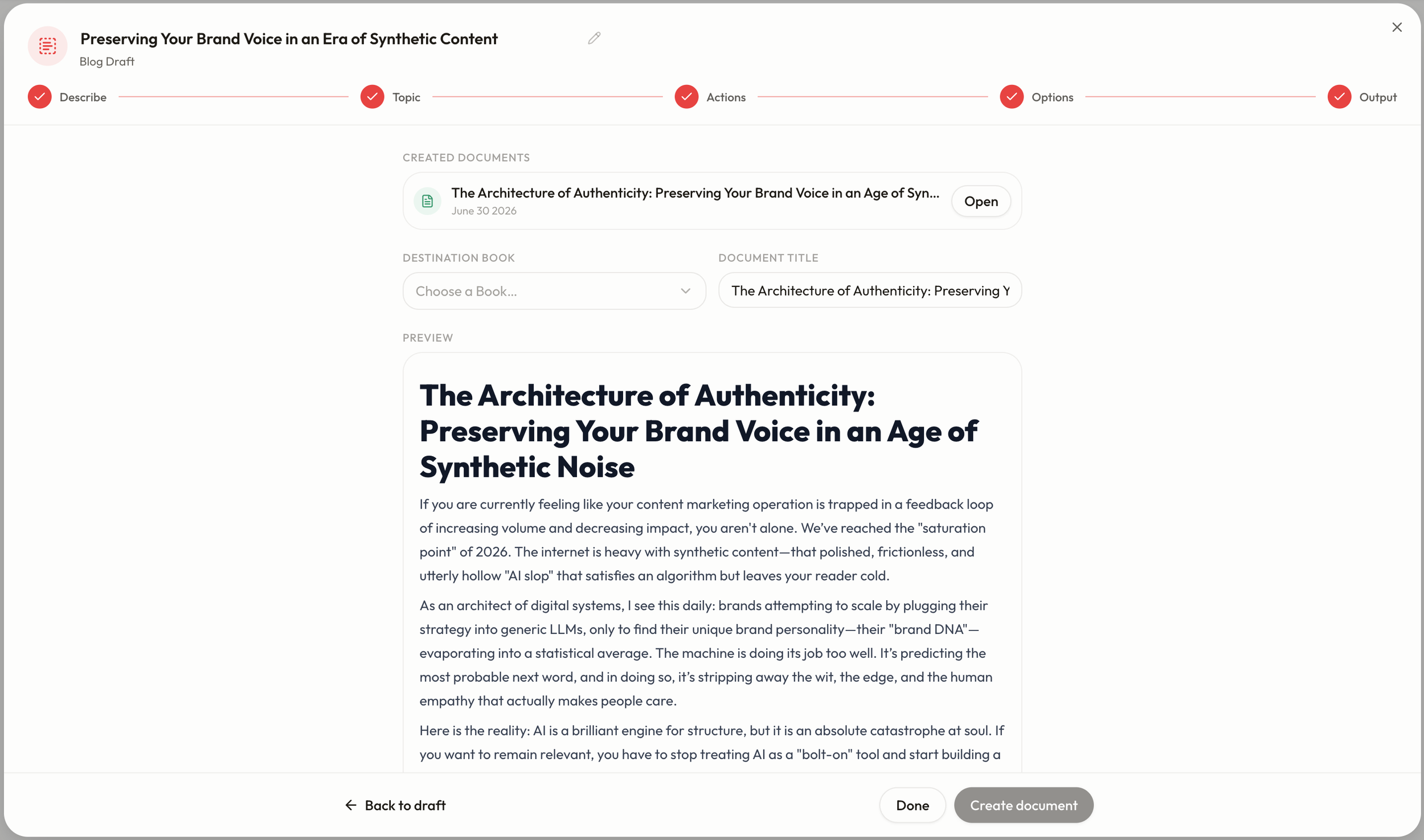
#1) Research and create a first draft with Riffuls “Blog Draft”
The first draft of this post was researched and generated using the Blog Draft experience
First, we described to post we wanted to create and let the AI provide suggested topics
Second, Actions were setup to have AI research the web and extract key insights and SEO for the blog topic
Finally, an initial draft document was created and saved to our workspace
#2) Fine-tune and polish with Riffuls “Blog Write”
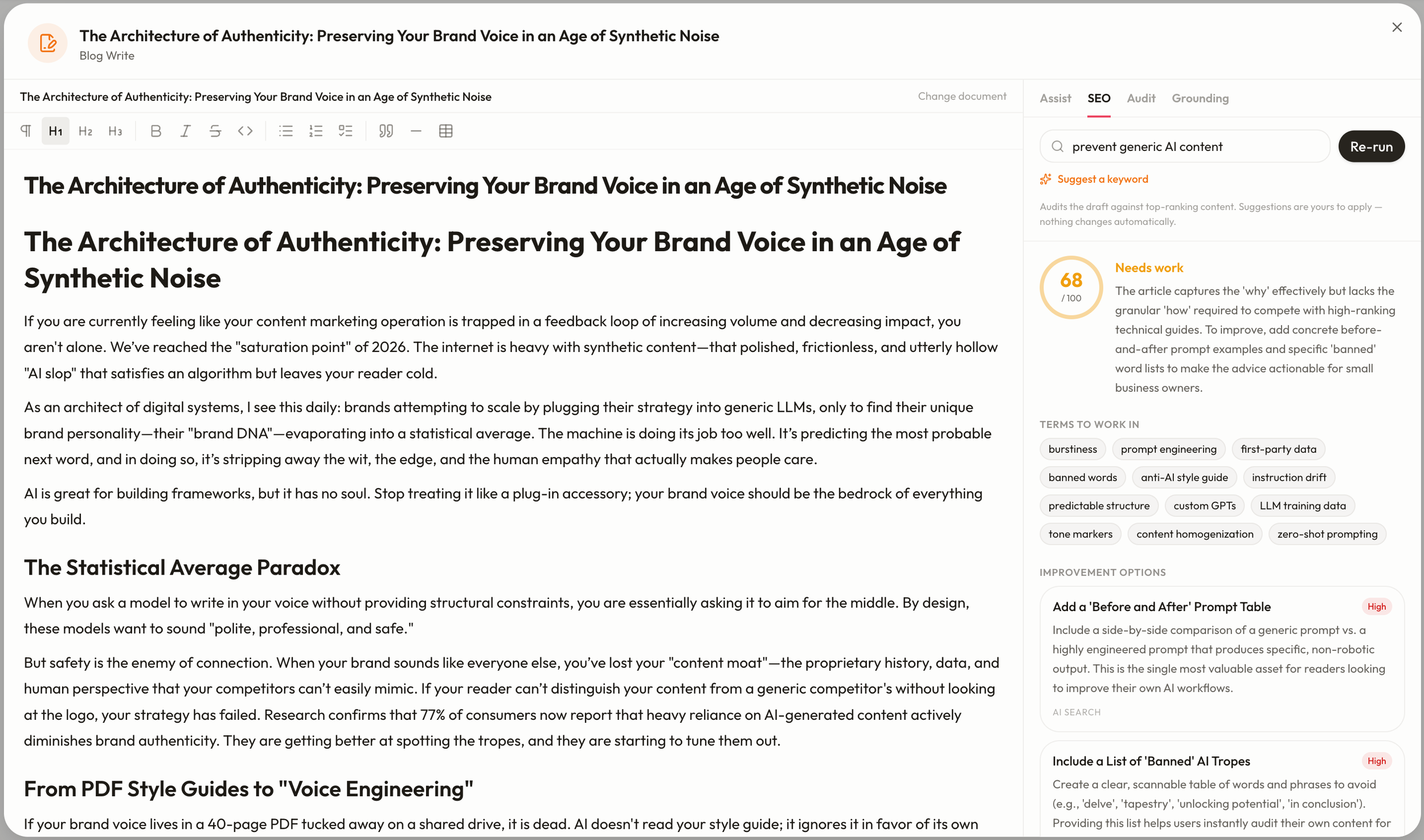
Once we had our initial draft it was time to polish and make it our own with the Write Together experience.
First, a manual pass to add anything missing, and re-write sections that we didn’t quite like
Second, we used the AI to make sure claims were fact checked and post was SEO optimized
Finally, an improve and polish pass with the AI to make sure it all sounded just right
#3) Create a relevant image with Riffuls “Image Create”
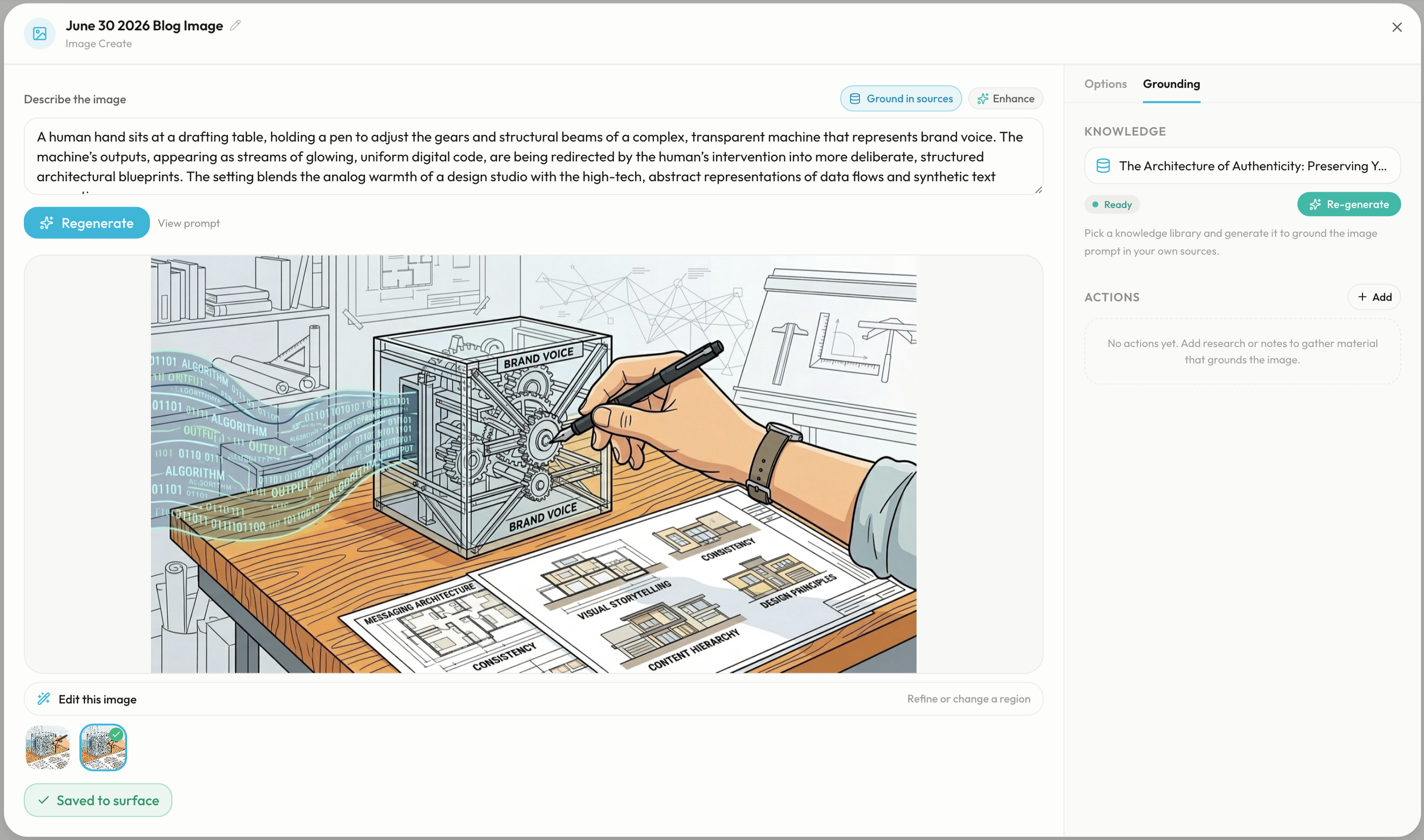
Finally, we created a header image that fit the post with the Image Create experience.
First, we added the blog to the source list to give the AI the right context
Second, we gave a brief description of the image and let the AI ground its own prompt in our blog source
Finally, we generated and tweaked a few examples until we got what we were after